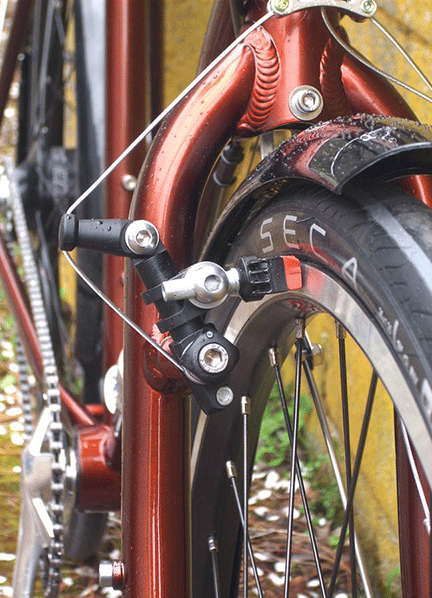
Prep Work:

  1. The brakes work best when the cables and housings have been lubricated. We use a little Tri-Flow in the housing and grease on the cable.
    Cable and Housing

  2. Attach the straddle saddle to the brake cable; normally between 10cm and 12cm above the middle of the canti studs. straddle saddle on cable
  3. Clean all the paint off of the cantilever studs on the frame with sandpaper. Paint on studs Sanding paint off sanding more paint off canti stud paint off studs
  4. Grease the studs and stud threads. grease on studs grease on stud  and threads
  5. Sand the brake pads until you remove the shine. brake pads with shine
  6. With the large Mathouser pads, sand down top and bottom to an angle, so they don't hang off the braking surface. sanded brake pad
  7. A little goes a long way with the coil springs. You don't need large adjustments.

Installation of the Brake

  1. Slide the arm in place with the spring mounts to the outside. Brake arm on stud brake arm on stud
  2. Slide the spring and spring tension cap into place. **The blue spring goes on the left side as you are facing the brakes.** Spring on brake tension cap on spring
  3. Tighten the arm in place after greasing the bolt threads and bolt head. installing the bolt tightening the bolt and brake arm
  4. Repeat with the other side. Remember, the blue spring goes on the left when facing the brake. blue spring on the left blue sring installed tension cap installation tightening the other arm down
  5. It should look like this now: brake installed brake installed close up
  6. Run the straddle cable (which is a mountain bike brake cable) through the straddle saddle. cable through straddle saddle
  7. Attach the cable to the bottom of one arm through the guide in the adjustable arm. close up of MTB brake cable
  8. Tighten the bolt-on cable end to adjust the cable at the bottom of the brake arm. sliding the cable stop onto the cable snugging the cable stop to the brake arm tightening the cable knarp
  9. Put a 16mm open wrench on the tension cap. 16mm wrench on the tension cap
  10. Put a 5mm hex wrench on the bolt to loosen the stud bolt slightly. 5mm allen key on the bolt
  11. While holding the 5mm wrench static, turn the 16mm wrench on the tension cap away from the wheel until the spring peg hole on the cap is straight above the mounting bolt. increasing brake tension
  12. Tighten the stud bolt down while holding the adjuster cap at the same spot. tightening the bolt
  13. Using a 4mm allen key, set the adjustable portion of the arm at about 45 degrees to start. adjustable brake arm tightening
  14. The pad holder is keyed for a 5mm allen key so you can hold it in place. The 10mm nut on the back is what you tighten to lock the angle and pad height. Setting the front of the pad to hit before the back (like in the pictures) will reduce brake squeal. brake pad lined up with rim tightening down the right brake pad tightening the left pad
  15. Squeeze the cable around the arm to set the cable. squeezing the cable at the adjustment arm

Adjustment

  1. To adjust the spring tension on the brake arms:
    • A little goes a long way. You don't need large adjustments
    • Think of the tension cap as a clock face: When adjusted properly the spring tab on the tension cap should be between 11 and 1
    • Use a 16mm wrench on the adjuster and hold the brake fixing bolt steady with a 5mm allen wrench.
    • To increase the tension, turn the cap away from the wheel.
  2. The best stopping occurs when the brakes feel nice and solid at the lever.
    • A 90 degree angle when the brake is pulled gives the best combination of stopping power and feeling of firmness. cable angle at 90 degrees
    • You can change the way braking feels by moving the straddle saddle up (firmer) or down (softer)
    • You can also change the angle of the adjustable portion of the arm in (firmer) or out (softer).
    • We've found that there is no need to set the brakes up a little "squishy" (i.e. using more mechanical advantage) in order to get maximum braking power.
  3. The adjustable arms are used to get the correct angle on the straddle cable as well as the feel correct.
    • The standard range of cantilever post width is 75mm to 85mm.
    • The narrower the posts are, the more upright the adjustable portion will be
    • The wider they are the wider the adjustable portion will be set.
  4. If you are using a cartridge style brake pad (such as the Matthauser pads that the brake ships with) make sure to set up the brake pads according to the directional arrows on the pads, otherwise the braking force can push the pad out of the holder.
    • If you are using a solid block pad (such as a Kool Stop Eagle Claw) the rear ones can be turned "backwards" (i.e. so that the long part of the pad faces forward) for better power.
    • The brake pad should be set as close to the arm as possible with a minimum amount of post showing.

Need more information? Contact us!